Buying Guides
Paper-Faced vs PS Film-Faced KT Board: How to Choose
The facing decides how a KT board prints, handles moisture and survives handling. Here is a practical way to choose between paper-faced and PS film-faced board — before you order a container.
Paper-Faced vs PS Film-Faced KT Board: How to Choose
Short answer: for a dry indoor print, start with paper-faced board. For a humid store, a retail display that will be handled again and again, or a piece that has to survive a wet mounting process, start with PS film-faced board. The core is the same in both cases. The facing is what changes how the board prints, how it handles moisture, and how long it looks good after it leaves the print room.
That is the whole decision in one paragraph. The rest of this article is for the jobs where the answer is not obvious — a large panel, a heavy ink load, a vinyl graphic, a framed print that has to stay flat for years.
We have made foam board in Foshan, Guangdong, since 2010, in two facings on the same single-piece extruded PS core. This article compares them by print surface, moisture, handling, and cost. No facing wins on all four. Those are the jobs where picking the wrong facing costs more than the price difference between the two boards.
What the facing changes — and what it does not
KT board is a sandwich: a polystyrene (PS) foam core between two facings. The core gives the board its thickness and rigidity. The facing gives it its surface.
Both facings sit on the same kind of core. Our 5 mm board uses a single-piece extruded PS core, not two thinner sheets glued together, so there is no glued joint to fail when the board is cut, printed, or stored in humidity.
What changes is the surface the ink, vinyl, or adhesive actually meets. Paper absorbs. Film does not, or not nearly as much. That one difference runs through everything that follows: how the ink dries, how the board reacts to a damp room, and how it behaves when someone picks it up for the tenth time.
Thickness is a separate decision. AB-KT, our PS film-faced board, is 3–10 mm. Paper-faced board, AB-HKZB, is also 3–10 mm, with 3, 5, 6, and 10 mm the usual sizes. Standard sheet size for both is 1220 × 2440 mm (4 × 8 ft), cut to size on request. Do not expect a facing change to fix a span problem: a 5 mm panel above roughly A1 size will flex whatever facing it has. For a large panel, move to 10 mm or add a frame or backing.
Paper-faced KT board
Our paper-faced board — model AB-HKZB — is our 5mm White Paper-Faced KT Board. It uses 127/157 g art paper, clay-coated, laminated to both sides of the core. The surface is smooth, matte, and familiar to any print shop: it takes digital printing, screen printing, vinyl, and mounted prints, and it cuts cleanly with a knife or guillotine.
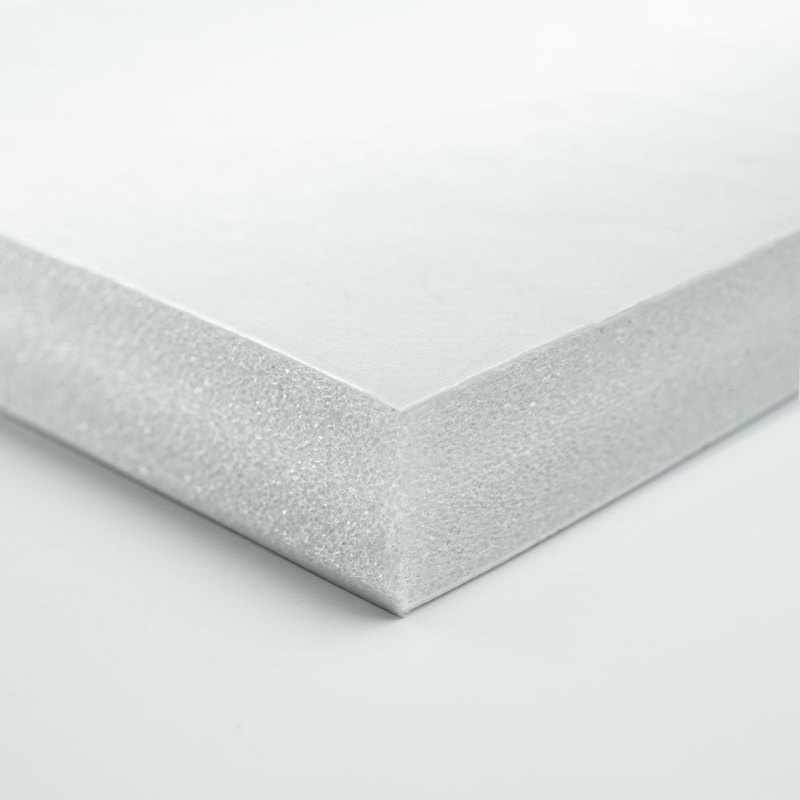
5 mm paper-faced KT board (AB-HKZB), 127/157 g art paper, 1220 × 2440 mm.
Paper-faced board is the usual choice for indoor printing, photo mounting, picture framing, POP displays, and short-term display. It costs more than PS film-faced board, and it is the surface most printers already know how to handle. Ink sits on art paper the way printers expect it to. A mounted print bonds to it without a special adhesive test in most cases — though, as with any board, test the actual adhesive on a sample before a production run.
Paper-faced board is available in white, black, and ultra-white. White is the default for printing; ultra-white gives a brighter print surface; black is for display work where the edge and face are meant to read as one dark surface.
The limitation is moisture. Paper absorbs water. In a damp store room, a humid press room, or a wet mounting process, one face can take on moisture faster than the other, and the board can cockle or bow. That is not a defect; it is what paper does. Keep the board flat, let it acclimatise in the press room for 24 hours before printing, and store it flat — or, if the job will live in humidity, choose the film facing instead.
Paper-faced board is not weatherproof. For outdoor graphics, use an exterior substrate or a protected location your fabricator has confirmed.
PS film-faced KT board
Our PS film-faced board — model AB-KT — is our 5mm White PS Film-Faced KT Board. Instead of paper, a PS film (or vinyl film) is laminated to the core. The film surface resists moisture and handling better than paper, which makes it the safer choice for humid stores, exhibition graphics, retail displays, and pieces that will be moved, handled, or reused.
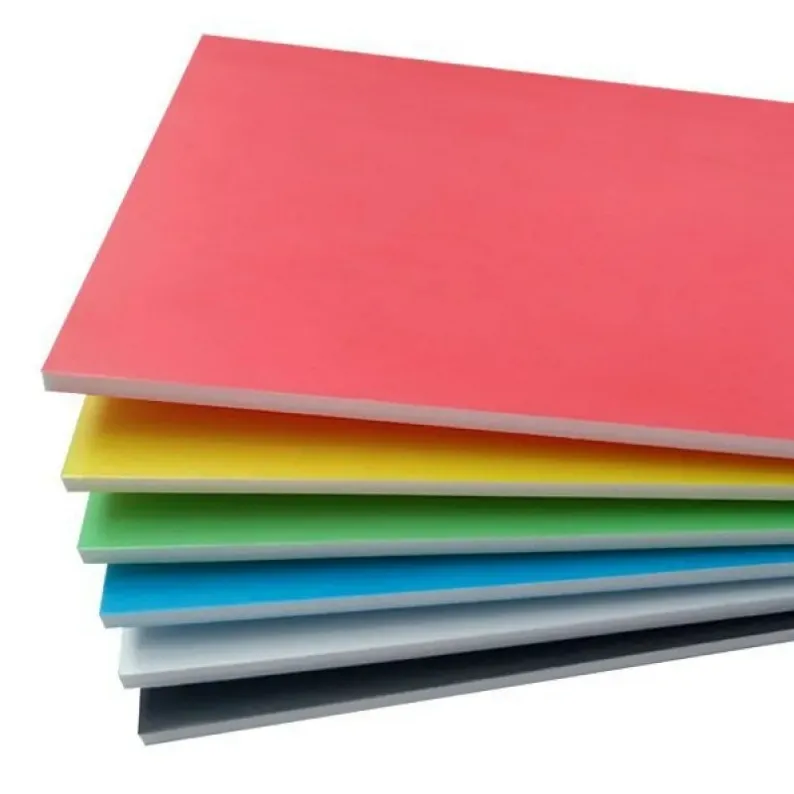
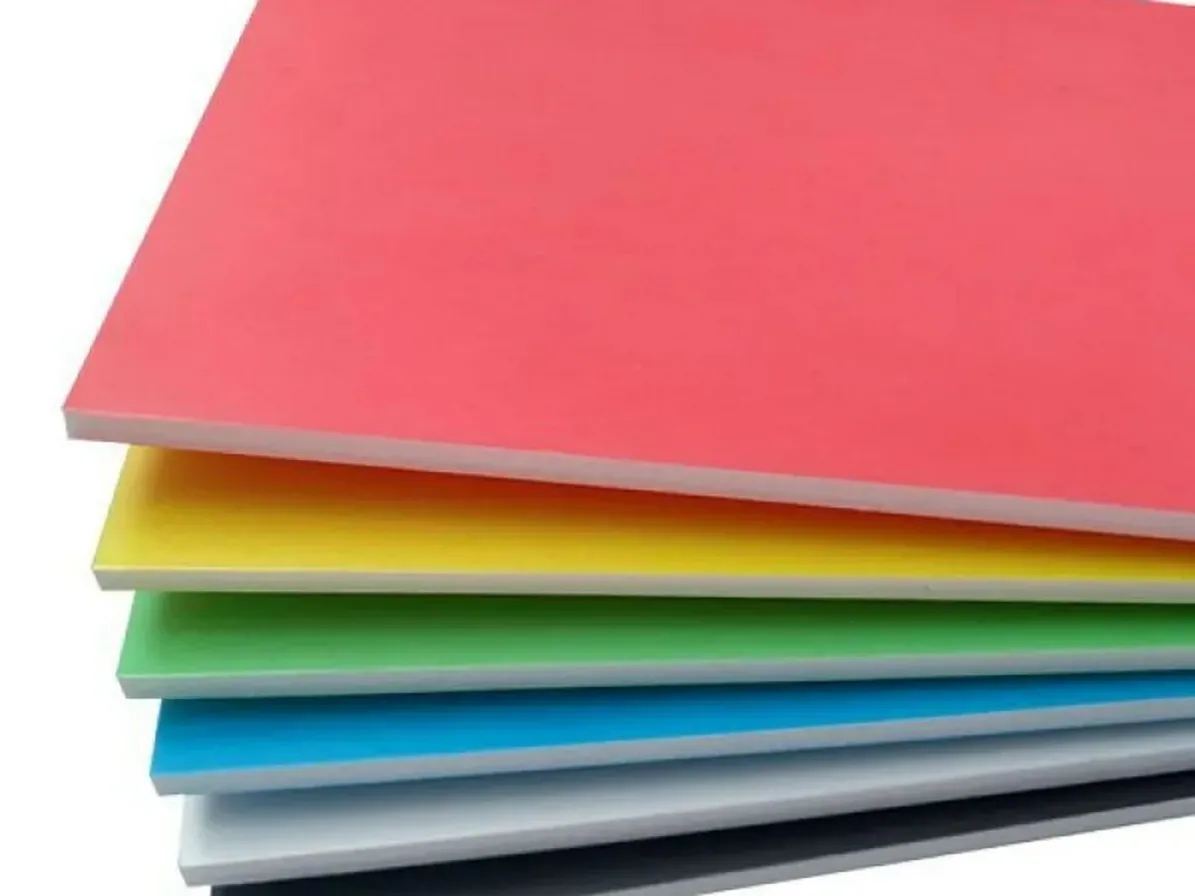
5 mm coloured PS film-faced KT board (AB-KT) — white, ultra-white, blue, green, red, and yellow.
PS film-faced board comes in 3–10 mm, in six colours: white, ultra-white, blue, green, red, and yellow. The coloured range is the 5mm Coloured PS Film-Faced KT Board. Colour here is the colour of the film itself, not a print on top of it, so the edge and the face read consistently — useful for display, art, models, and colour-coded work where the board is part of the look, not just a carrier for a print.
The trade-off is the print surface. Film behaves differently from paper under ink and adhesive. Ink dries differently, vinyl adhesion needs checking, and a heavy ink load can sit on the surface rather than soaking in. None of that means film does not print. It means you test it: print a small graphic on a sample, apply the actual vinyl, and check adhesion after 24 hours, before a production run. The same applies to screen printing.
Film-faced board costs less than paper-faced board. That lower price is one reason it is the usual choice for signage, retail and exhibition runs. But do not pick film for a dry indoor print just to save money if the job needs paper’s print surface — pay the premium for paper where its surface justifies it, and test ink and vinyl adhesion on a sample first either way.
The comparison
Question | Paper-faced (AB-HKZB) | PS film-faced (AB-KT) |
Print surface | Smooth 127/157 g art paper; familiar ink absorption | PS film; test ink and vinyl adhesion on a sample |
Moisture | Sensitive — paper absorbs water | Resistant — film absorbs far less |
Handling | Indoor, light handling | Repeated handling, retail and exhibition use |
Cost | Higher | Lower |
Colours | White, black, ultra-white | White, ultra-white, blue, green, red, yellow |
Thickness | 3–10 mm, usual 3/5/6/10 mm | 3–10 mm |
Best for | Indoor prints, photo mounting, framing, POP | Signage, POP, exhibition, humid spaces, coloured display |
Read the table as a starting point, not a verdict. A humid print room can push an indoor job toward film. A dry gallery can keep a framed piece on paper for years. The job decides, and the sample test below settles the close calls.
How to choose
Ask these four questions in order. Most jobs are decided by the first two.
- Where will the piece live? A dry indoor wall, a frame, a short-run poster: paper-faced. A humid store, a covered display area, an exhibition hall, or a piece that will be handled and moved: PS film-faced. If the location is damp and the piece is large, choose film and a thicker board — the facing handles the moisture, the thickness handles the span.
- How will it be printed? Digital and screen printing on paper is the familiar route. Vinyl graphics can work on either facing, but the adhesive must be tested on the actual surface. Solvent inks and heavy ink coverage behave differently on film than on paper, so confirm ink and drying on a sample. If the print method is fixed and the facing fights it, change the facing, not the print method.
- How large is the panel? Above roughly A1, specify a thicker board and support the panel. The facing alone will not solve a span problem. For large panels, see the PS Film-Faced KT Board range and the 10 mm paper-faced option, and confirm the span and support method before you specify.
- What is the budget? PS film-faced is the lower-cost choice. Paper-faced board costs more, so pay the premium for paper where its print surface and mounting behaviour justify it. The expensive mistake is not the higher price of paper — it is a container of paper-faced board that warps in a humid warehouse, or a run of film-faced board printed with an untested ink that does not adhere.
A sample test that takes one day
Print a small graphic on both facings. Cut a 300 × 300 mm panel of each. Leave one in a dry room and one in the most humid space you have. Check for curl, edge swelling, and ink adhesion after 24 hours. Then mount a print on each and repeat.
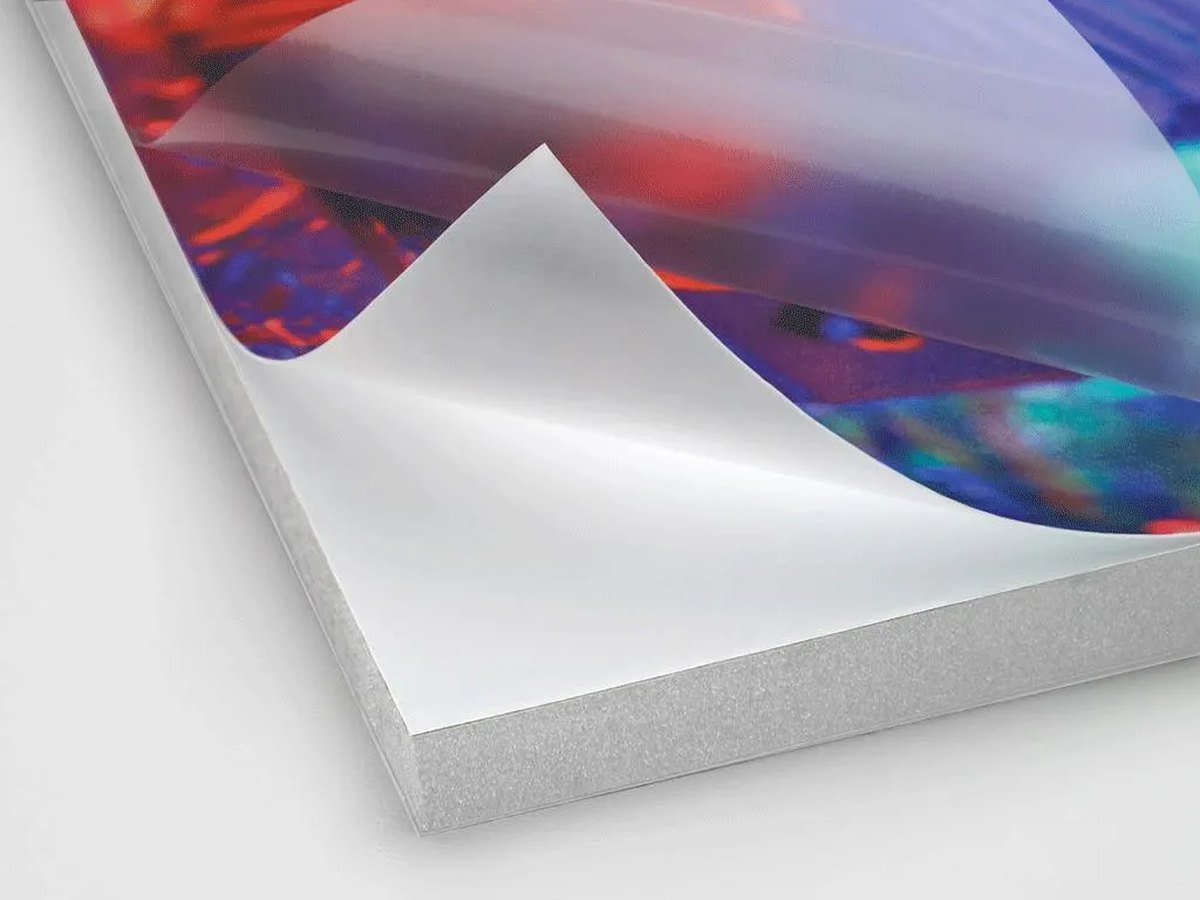
Test the actual ink or vinyl on a sample before a production run.
The result will tell you more than a specification sheet: how your ink behaves on each surface, how each facing reacts to your humidity, and whether the board stays flat under your conditions. We provide free samples, with courier cost refunded on a later order. Regular sizes are stocked. Custom orders are normally 20–25 days after specification and sample approval.
Next step
Request a sample — tell us the application, the print process, and the panel size. We will confirm the facing, thickness, and packing for your job, and send a paper-faced and a PS film-faced sample so you can run the one-day test yourself.
FAQ
Can I print on PS film-faced board with a normal digital printer?
Usually yes, but test it first. Film dries and holds ink differently from art paper. Print a small graphic on a sample with your actual ink and settings, check adhesion and drying after 24 hours, and only then run the job.
Which facing is better for picture framing?
Paper-faced board is the usual choice for dry indoor framing — it mounts easily and prints well. If the frame will hang in a humid room or be handled often, PS film-faced board holds its shape longer. Test both if the piece matters.
Is coloured KT board just white board with a coloured print?
No. On our coloured PS film-faced board, the colour is in the film facing itself — blue, green, red, yellow, white, or ultra-white — so the face and the edge read as one colour. That is why it is used for display, models, and colour-coded work.